Understanding APIs
An API, or Application Programming Interface, is a set of rules and protocols that allows different software applications to communicate with each other. It defines the methods and data formats that applications can use to request and exchange information. APIs are essential in modern software development because they enable the integration of disparate systems and the development of complex functionalities without needing to build everything from scratch.
Uses of APIs:
- Integration: APIs allow different software systems to interact seamlessly. For instance, a payment gateway API enables e-commerce platforms to process transactions without having to develop their own payment processing systems.
- Data Sharing: APIs facilitate data exchange between systems, which is crucial for applications that rely on real-time data. Social media platforms, for example, use APIs to allow third-party apps to access user data (with permission).
- Functionality Extension: APIs enable developers to extend the functionality of applications by leveraging external services. For example, a weather API can be used to integrate weather data into a travel app.
- Automation: APIs can automate workflows by connecting various tools and services. For example, APIs in continuous integration/continuous deployment (CI/CD) pipelines automate software testing and deployment.
Commonly Used API Architecture Patterns
There are various architectural styles for building APIs, each with its own strengths and use cases. Six of the most commonly used API architecture styles are:
- REST (Representational State Transfer)
- gRPC (gRPC Remote Procedure Calls)
- GraphQL
- SOAP (Simple Object Access Protocol)
- WebSockets
- WebHooks
1. REST (Representational State Transfer)
Overview:
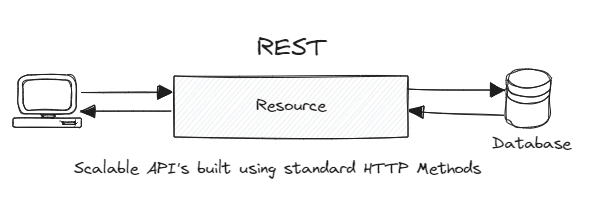
REST is an architectural style that uses HTTP requests to access and use data. It is based on stateless, client-server communication where each call from a client to server must contain all the information needed to understand and process the request.
Key Features:
- Stateless: Each request from a client to server must contain all the information the server needs to fulfill the request.
- Cacheable: Responses must explicitly indicate whether they are cacheable to improve performance.
- Uniform Interface: Simplifies and decouples the architecture, which enables each part to evolve independently.
- Layered System: The client is unaware whether it is connected directly to the end server or an intermediary along the way.
Example:
A common example of a RESTful API is one that provides data about books. For instance, a GET request to /books could return a list of books, while a POST request to /books with the relevant data in the request body could add a new book.
Diagram:
Usage:
REST is the most commonly used API style and is widely used for its simplicity and scalability, making it suitable for web services and applications where stateless operations are beneficial.
2. gRPC (gRPC Remote Procedure Calls)
Overview:
gRPC is a high-performance, open-source framework developed by Google. It uses HTTP/2 for transport, Protocol Buffers (protobuf) as the interface description language, and supports multiple programming languages.
Key Features:
- Efficient: Uses HTTP/2 which allows for multiplexing multiple requests over a single connection.
- Strongly Typed: Uses Protocol Buffers for defining service methods and message types.
- Bi-directional Streaming: Supports streaming requests and responses.
- Language Agnostic: Supports multiple programming languages.
Example:
A gRPC service for a book store might have methods like GetBook, ListBooks, and AddBook, with each method defined in a .proto file and implemented in the server code.
Diagram:

Usage:
gRPC is ideal for microservices architectures, mcro services communication and scenarios where low latency and high throughput are critical, such as real-time communications and IoT applications.
3. GraphQL
Overview:
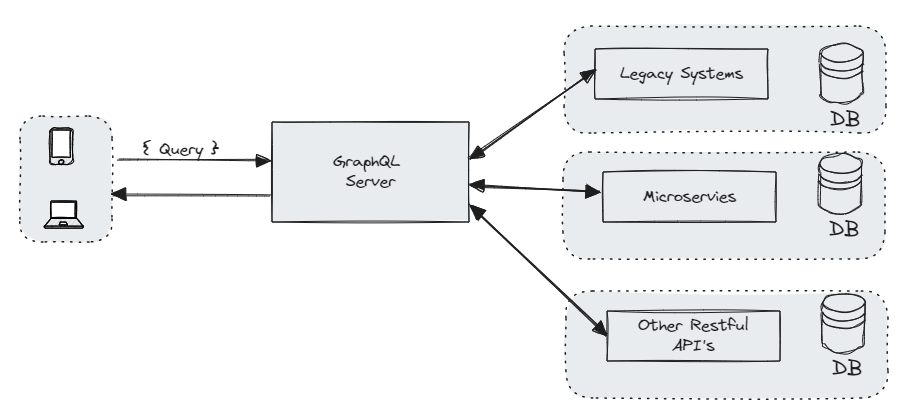
GraphQL is a query language for APIs and a runtime for executing those queries. Developed by Facebook, it allows clients to request exactly the data they need, making it highly efficient and flexible.
Key Features:
- Declarative: Clients specify what data they need, and the server returns only that data.
- Hierarchical: The shape of the response mirrors the shape of the query.
- Strongly Typed: Uses a schema to define types and relationships between types.
- Real-time Data: Supports subscriptions to enable real-time updates.
Example:
A GraphQL query for a book store might look like:
{
  books {
    title
    author {
      name
    }
  }
}
This query requests a list of books with each book’s title and author’s name.
Diagram:
Usage:
GraphQL is suitable for applications with complex data requirements and where minimizing data over-fetching and under-fetching is important, such as mobile and web apps.
4. SOAP (Simple Object Access Protocol)
Overview:
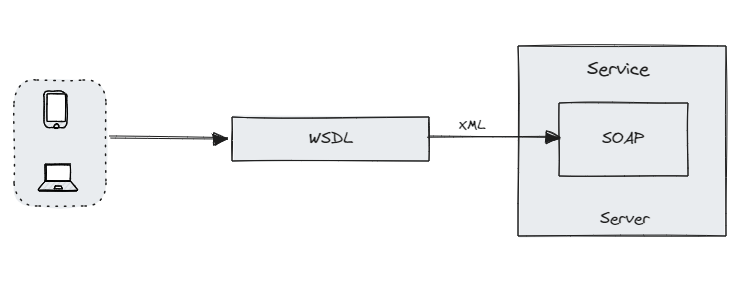
SOAP is a protocol for exchanging structured information in web services using XML. It relies on a set of standards such as WSDL (Web Services Description Language) and XSD (XML Schema Definition).
Key Features:
- Protocol-Based: Uses XML-based messaging protocol.
- Strict Standards: Adheres to strict standards and protocols, ensuring robust and secure communication.
- WS-Security: Built-in security features.
- Extensible: Supports extensions for additional features.
Example:
A SOAP request to a book store service might look like:
<soapenv:Envelope xmlns:soapenv="http://schemas.xmlsoap.org/soap/envelope/" xmlns:book="http://example.com/bookstore">
   <soapenv:Header/>
   <soapenv:Body>
      <book:GetBookRequest>
         <book:ISBN>1234567890</book:ISBN>
      </book:GetBookRequest>
   </soapenv:Body>
</soapenv:Envelope>
Diagram:
Usage:
SOAP is often used in enterprise environments where strict standards, security, and reliability are critical, such as banking and telecommunications.
5. WebSockets
Overview:
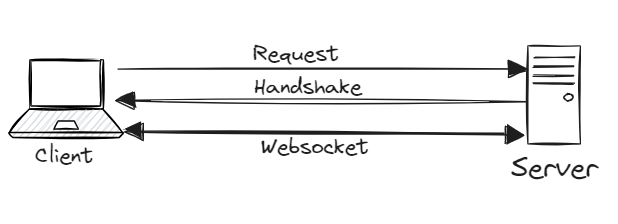
WebSockets provide a full-duplex communication channel over a single, long-lived connection, allowing for real-time data transfer between a client and server.
Key Features:
- Full-Duplex: Allows for two-way communication.
- Persistent Connection: Keeps the connection open, enabling real-time interaction.
- Low Latency: Minimizes latency by avoiding repeated HTTP requests.
Example:
A WebSocket connection to a book store service might be used to provide real-time updates on book availability. The client establishes a connection to the server and subscribes to updates.
Diagram:
Usage:
WebSockets are ideal for applications requiring real-time updates, such as live chats, online gaming, and live financial data feeds.
6. WebHooks
Overview:
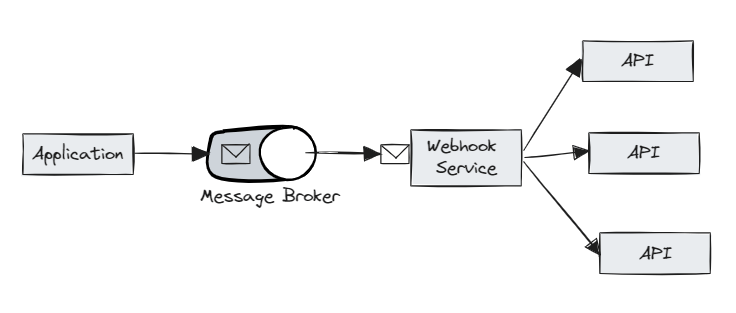
WebHooks are a way for one system to send real-time data to another system as soon as an event occurs. They are HTTP callbacks triggered by specific events.
Key Features:
- Event-Driven: Triggered by specific events in one system to notify another system.
- Real-Time: Provides real-time data transfer.
- Simple: Easy to implement and use.
Example:
A WebHook for a book store might be configured to send a POST request to a URL whenever a new book is added to the inventory. The receiving system can then process this data as needed.
Diagram:
Usage:
WebHooks are commonly used for integrations between different systems, such as connecting a CRM system with an email marketing platform, or triggering CI/CD pipelines in software development.
Conclusion
APIs are essential for enabling communication between different software systems. The choice of API architecture style depends on the specific requirements of the application, such as the need for real-time communication, strict standards, or flexible data querying. By understanding the strengths and use cases of each style—REST, gRPC, GraphQL, SOAP, WebSockets, and WebHooks—developers can design APIs that best meet their needs.
 FactorBytes
Leave a comment