The TCP 3-Way Handshake is a fundamental process in the Transmission Control Protocol (TCP) that establishes a reliable connection between two devices over a network. This handshake ensures that both the sender and receiver are ready to exchange data and sets up the necessary parameters for a reliable and error-free transmission. As software engineers and architects one should have adequate knowledge about networking, protocols and how communication happens. Let’s explore the TCP 3-Way Handshake in detail.
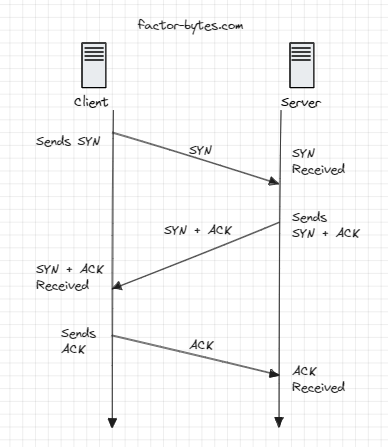
- SYN (Synchronize) – Step 1:
The process begins with the initiating device, often referred to as the client, sending a SYN packet (called a Synchronization Sequence Number) to the receiving device, known as the server. The SYN packet contains a sequence number, which is a randomly chosen value that starts the sequence of bytes for the connection. This initial sequence number is used to keep track of the data transmitted between the two devices. - SYN-ACK (Synchronize-Acknowledge) – Step 2:
Upon receiving the SYN packet, the server responds by sending a SYN-ACK packet back to the client. The SYN-ACK packet contains an acknowledgment number, which is set to one more than the received sequence number. This acknowledges the receipt of the client’s SYN packet and indicates that the server is ready to establish the connection. Additionally, the server also generates its own initial sequence number, which will be used for data transmission from the server to the client. - ACK (Acknowledge) – Step 3:
After the client receives the SYN-ACK packet, it sends an ACK packet back to the server. The ACK packet’s acknowledgment number is set to the received sequence number from the server’s SYN-ACK packet plus one. This final ACK packet confirms the establishment of the connection and acknowledges the server’s initial sequence number.
Once the 3-Way Handshake is complete, both devices have agreed upon the initial sequence numbers and are ready to exchange data reliably. From this point on, they can use the established connection for bidirectional data transmission.
It’s important to note that the TCP 3-Way Handshake ensures reliability by confirming that both devices are actively listening and capable of sending and receiving data. It also helps prevent connection attempts to non-existent or inactive devices, reducing unnecessary network overhead. Understanding the 3-Way Handshake is crucial for troubleshooting network connectivity issues and optimizing TCP-based applications for efficient data transmission.


Leave a comment