Network communication is part of networking however, Software architects should be familiar with basic networking and the TCP/IP model at least because it forms the foundation of modern networking and internet communication. Understanding the model helps architects design software systems that effectively utilize network protocols and services, ensuring seamless data exchange between devices. Knowledge of TCP/IP aids in optimizing application performance, addressing security concerns, and troubleshooting network-related issues, ultimately leading to more robust, scalable, and reliable software solutions in today’s interconnected world.
The TCP/IP model, short for Transmission Control Protocol/Internet Protocol, is a robust and widely used networking framework that underpins the entire internet. It is a suite of communication protocols that enables devices to connect and communicate across networks, both locally and globally. In this blog, we will explore the TCP/IP model, dissecting its four layers and understanding how it facilitates data transmission, routing, and networking in the digital age.
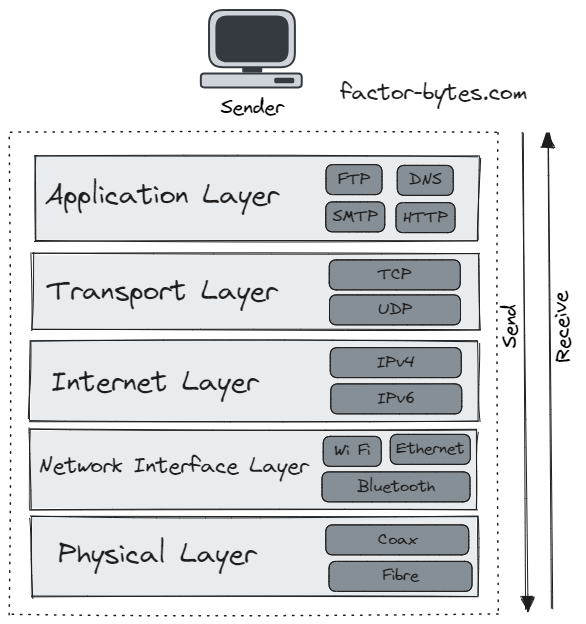
Layer 1: Physical Layer
The Physical Layer is not explicitly defined in the TCP/IP Model and is usually part of Link Layer and works similarly to the OSI’s Physical layer i.e. it handles the transmission of raw bits over the physical medium. It focuses on hardware-related aspects, such as cables, connectors, and switches. This layer establishes and terminates physical connections and defines the electrical and mechanical characteristics of the transmission medium. The Physical Layer is responsible for transmitting data as electrical or optical signals from one device to another.
Layer 2: Link Layer (Network Interface Layer)
Next at the bottom of the TCP/IP model lies the Link Layer, also known as the Network Interface Layer or the Network Access Layer. This layer is responsible for establishing a physical connection between devices over a local network. It deals with hardware-specific communication technologies, such as Ethernet, Wi-Fi, and Bluetooth.
The Link Layer is tasked with encapsulating IP packets into data frames and managing the physical addressing of devices using MAC (Media Access Control) addresses. It ensures reliable data transfer between directly connected devices within the same network segment.
Layer 3: Internet Layer
Sitting on top of the Link Layer, the Internet Layer is where the heart of the TCP/IP model lies. It primarily deals with IP addressing, routing, and forwarding of data packets across multiple networks or subnets.
The Internet Layer uses IP addresses to uniquely identify devices on a network. It also includes the Internet Control Message Protocol (ICMP), which is responsible for error reporting, network diagnostics, and helping routers communicate with each other.
IP is the key protocol of this layer, and its version determines whether it is IPv4 or IPv6. IPv4, the older version, uses 32-bit addresses, while IPv6, the newer version, uses 128-bit addresses to accommodate the growing number of connected devices on the internet.
Layer 4: Transport Layer
Moving up the TCP/IP model, we encounter the Transport Layer, responsible for end-to-end communication between devices and applications. It provides reliable and orderly data delivery services and ensures that data packets are delivered without errors and in the correct order.
The following are the two most widely used transport layer protocols:
- Transmission Control Protocol (TCP): TCP is connection-oriented and provides reliable data transmission. It establishes a connection between the sending and receiving devices before data exchange, manages flow control, retransmits lost data, and guarantees the delivery of packets in the correct order.
- User Datagram Protocol (UDP): UDP, on the other hand, is connectionless and offers faster data transmission without the overhead of establishing and maintaining a connection. However, it does not guarantee data delivery or order, making it suitable for applications that prioritize speed over reliability, such as real-time video streaming and VoIP.
Layer 5: Application Layer
The topmost layer of the TCP/IP model is the Application Layer, responsible for interacting directly with end-users and providing access to network services and applications.
This layer houses a plethora of protocols and services, including but not limited to:
- Hypertext Transfer Protocol (HTTP): Used for web browsing and accessing websites.
- Simple Mail Transfer Protocol (SMTP): Facilitates email delivery.
- File Transfer Protocol (FTP): Enables file transfers between devices.
- Domain Name System (DNS): Translates human-readable domain names into IP addresses.
The Application Layer allows various applications to communicate over the internet by providing a common set of protocols and services that ensure seamless data exchange.
As technology advances and the internet continues to evolve, the TCP/IP model remains a critical framework for facilitating global communication and connectivity in an interconnected world.
How communication happens in TCP/IP model
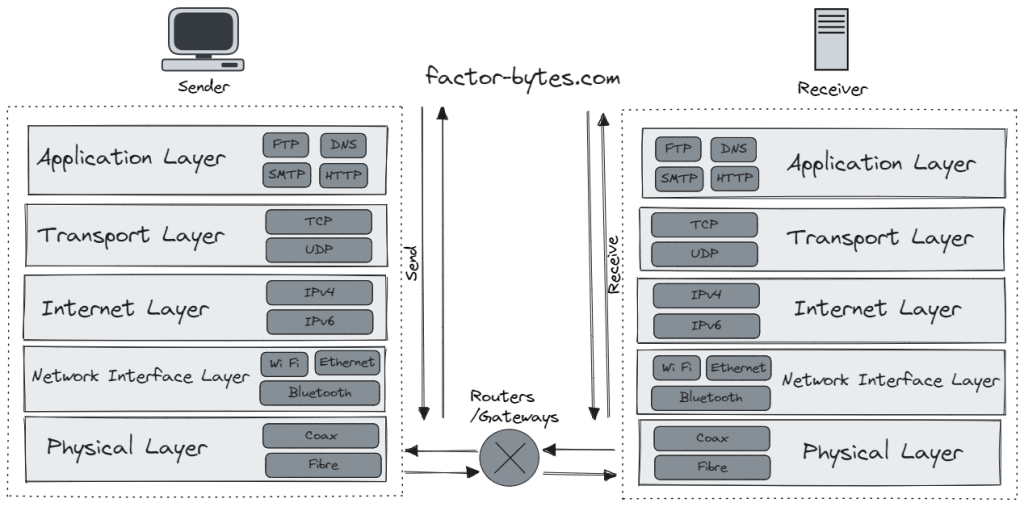
In the TCP/IP model, communication happens through a series of steps involving the interaction of various layers. Let’s walk through the process:
- Data Encapsulation: When a higher-layer application, like a web browser, wants to send data to another device, the data is passed down through the layers of the TCP/IP model.
- Application Layer (Layer 4): The application layer prepares the data for transmission, appending headers specific to the application protocol being used (e.g., HTTP, FTP, SMTP). The data is now referred to as a message or a packet.
- Transport Layer (Layer 3): The transport layer further encapsulates the message by adding its own header, which includes information about source and destination ports and the selected transport protocol (TCP or UDP).
- Internet Layer (Layer 2): The internet layer adds its header, which includes the source and destination IP addresses, to the packet. This layer is responsible for routing the packet across multiple networks or subnets.
- Link Layer (Layer 1): The link layer adds the final header, including the MAC addresses of the source and destination devices on the local network. The packet is now ready to be transmitted over the physical medium (e.g., Ethernet, Wi-Fi).
- Data Transmission: The packet traverses the physical medium from the source device to the destination device, passing through intermediate network devices like routers and switches as needed.
- Receiving and Decapsulation: At the destination device, the packet moves up through the layers of the TCP/IP model, with each layer stripping off its respective header.
- Data Reassembly: The transport layer at the destination reassembles the data based on the sequence numbers and acknowledgments received from the sender, ensuring data integrity and order.
- Handing Data to Application: Finally, the application layer at the destination receives the original data from the sender’s application layer, making it available for use by the receiving application (e.g., web browser, email client).
This process ensures reliable and orderly data transmission across networks, with each layer performing specific tasks that contribute to successful communication. The TCP/IP model’s modular and hierarchical design allows for flexibility, scalability, and compatibility, making it the backbone of Internet communication.
 FactorBytes
Leave a comment