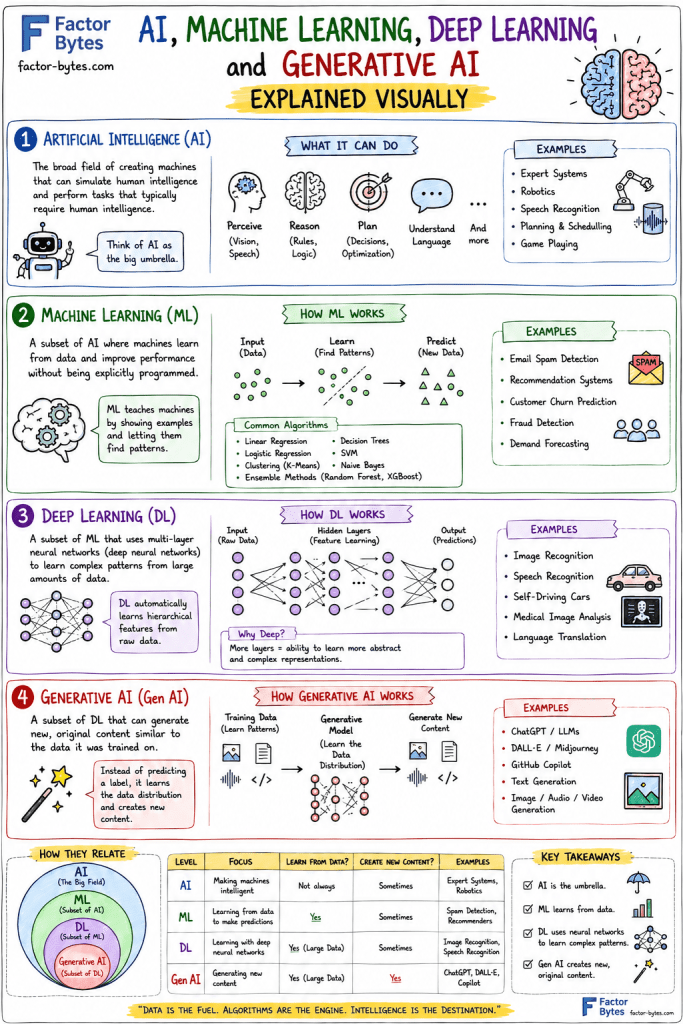
“Data is the fuel. Algorithms are the engine. Intelligence is the destination.”
Artificial Intelligence is everywhere today.
Open any technology news site, attend a conference, browse LinkedIn, or sit in a boardroom discussion, and you’ll hear terms like AI, Machine Learning, Deep Learning, Large Language Models, and Generative AI being used almost interchangeably.
The problem?
Most people understand these terms individually, but very few understand how they relate to one another.
As architects and engineers, we often encounter situations where business stakeholders ask:
- Can we use AI for this?
- Should we build a Machine Learning model?
- Is Deep Learning required?
- Can Generative AI solve this problem?
Before answering these questions, we need to understand the relationship between these technologies.
Think of them as nested layers rather than completely separate concepts.
In this article, we’ll explore Artificial Intelligence (AI), Machine Learning (ML), Deep Learning (DL), and Generative AI (Gen AI) using simple explanations, practical examples, and visual thinking.
The Big Picture
Imagine four circles placed inside each other.
Artificial Intelligence └── Machine Learning └── Deep Learning └── Generative AI
Each layer is a subset of the previous one.
Not all AI uses Machine Learning.
Not all Machine Learning uses Deep Learning.
And not all Deep Learning systems are Generative AI.
Understanding this hierarchy removes much of the confusion surrounding today’s AI landscape.
Artificial Intelligence (AI): The Big Umbrella
Artificial Intelligence is the broad discipline of building systems that can perform tasks that typically require human intelligence.
These tasks include:
- Understanding language
- Solving problems
- Planning actions
- Recognizing patterns
- Making decisions
Think of AI as the Goal
The objective is simple:
Build machines that can exhibit intelligent behavior.
Interestingly, AI existed long before ChatGPT.
Examples of traditional AI include:
- Expert systems
- Rule engines
- Chess-playing programs
- Robotics
- Speech recognition systems
Many early AI systems did not learn from data.
Instead, they relied on predefined rules created by humans.
Everyday Example
When Google Maps suggests the best route to your destination, it is applying AI techniques to solve a problem intelligently.
The system evaluates multiple possibilities and recommends the optimal path.
Machine Learning (ML): Learning from Data
As systems became more complex, engineers realized something important.
Writing rules for every possible scenario was becoming impossible.
Instead of teaching machines every rule, what if machines could learn patterns from data?
That idea gave birth to Machine Learning.
What is Machine Learning?
Machine Learning is a subset of AI where systems learn patterns from historical data and improve over time without being explicitly programmed.
Instead of:
Rules → Output
Machine Learning follows:
Data → Learning → Prediction
Common Machine Learning Applications
You interact with Machine Learning every day.
Examples include:
- Email spam detection
- Product recommendations
- Fraud detection
- Customer churn prediction
- Demand forecasting
A Simple Analogy
Imagine teaching a child to identify a cat.
Traditional programming:
You provide hundreds of rules.
- Has whiskers
- Has four legs
- Has a tail
- Says meow
Machine Learning:
You simply show thousands of cat images.
The model learns the patterns itself.
This ability to learn from examples is what makes Machine Learning so powerful.
Deep Learning (DL): Learning Complex Patterns
As data volumes exploded, researchers discovered that traditional Machine Learning had limitations.
Some problems were simply too complex.
For example:
- Recognizing faces
- Understanding speech
- Translating languages
- Detecting diseases from medical scans
To solve these challenges, Deep Learning emerged.
What is Deep Learning?
Deep Learning is a subset of Machine Learning that uses artificial neural networks with multiple layers.
The term “deep” refers to the number of layers within these neural networks.
These layers gradually learn increasingly complex representations of data.
Why Deep Learning Matters
Imagine recognizing a face.
A traditional Machine Learning model may require engineers to manually define features.
Deep Learning automatically learns:
Layer 1:
- Edges
Layer 2:
- Shapes
Layer 3:
- Facial features
Layer 4:
- Complete faces
The deeper the network, the more sophisticated the learned representations become.
Common Deep Learning Applications
- Image recognition
- Speech recognition
- Language translation
- Self-driving cars
- Medical image analysis
Deep Learning transformed AI because it significantly reduced the need for manual feature engineering.
The system learns what matters.
Generative AI: Creating Instead of Predicting
Most Machine Learning and Deep Learning systems focus on prediction.
For example:
- Will this customer leave?
- Is this email spam?
- Is this image a cat or a dog?
Generative AI takes a completely different approach.
Instead of predicting labels, it creates new content.
What is Generative AI?
Generative AI is a subset of Deep Learning that learns patterns from existing data and generates new, original content.
This content may include:
- Text
- Images
- Audio
- Video
- Code
Examples of Generative AI
You have probably already used some of these tools:
- ChatGPT
- GitHub Copilot
- DALL-E
- Midjourney
- Claude
- Gemini
These systems don’t retrieve answers like a database.
Instead, they generate responses based on patterns learned from enormous amounts of training data.
Think Like a Chef
I often explain Generative AI using a cooking analogy.
Imagine:
AI is the chef.
Machine Learning is learning recipes from previous cooks.
Deep Learning is mastering thousands of ingredients and cooking techniques.
Generative AI is creating an entirely new dish that has never existed before.
The chef is not copying.
The chef is creating.
That is the essence of Generative AI.
How Generative AI Actually Works
At a high level, the process is surprisingly simple.
Step 1: Massive Training Data
The model is trained on enormous datasets containing text, images, code, audio, and more.
Step 2: Pattern Learning
The neural network learns relationships and structures hidden within the data.
Step 3: User Prompt
A user provides an instruction.
For example:
Write a blog on Artificial Intelligence.
Step 4: Content Generation
The model predicts and generates the most appropriate response based on its learned patterns.
Step 5: New Content Creation
The result may be:
- Text
- Image
- Code
- Audio
- Video
This generated content did not exist before.
The model created it.
A Quick Comparison
| Technology | Primary Focus | Learns From Data | Creates New Content |
|---|---|---|---|
| AI | Intelligent behavior | Not always | Sometimes |
| Machine Learning | Pattern learning | Yes | Limited |
| Deep Learning | Complex pattern learning | Yes | Limited |
| Generative AI | Content generation | Yes | Yes |
Why Architects Should Care
As technology professionals, understanding these distinctions is becoming increasingly important.
When someone says:
“Let’s use AI.”
The next question should be:
“What kind of AI?”
Because different problems require different approaches.
A recommendation engine may need Machine Learning.
Medical image analysis may require Deep Learning.
An enterprise knowledge assistant may benefit from Generative AI and Retrieval-Augmented Generation (RAG).
Choosing the right approach is often more important than choosing the latest technology.
Final Thoughts
Artificial Intelligence is the umbrella.
Machine Learning enables systems to learn from data.
Deep Learning enables systems to learn complex representations.
Generative AI enables systems to create entirely new content.
Understanding this hierarchy helps us move beyond the hype and focus on solving real business problems.
As architects and engineers, our responsibility is not to use AI because it is fashionable.
Our responsibility is to understand where it fits, where it adds value, and where it doesn’t.
Because at the end of the day, technology is not about algorithms.
It is about solving problems.
And AI is simply another powerful tool in that journey.
Key Takeaway
AI is the umbrella. ML learns from data. DL learns complex patterns. Gen AI creates new content.
Understanding these four concepts is the first step toward designing intelligent systems for the future.


Leave a comment