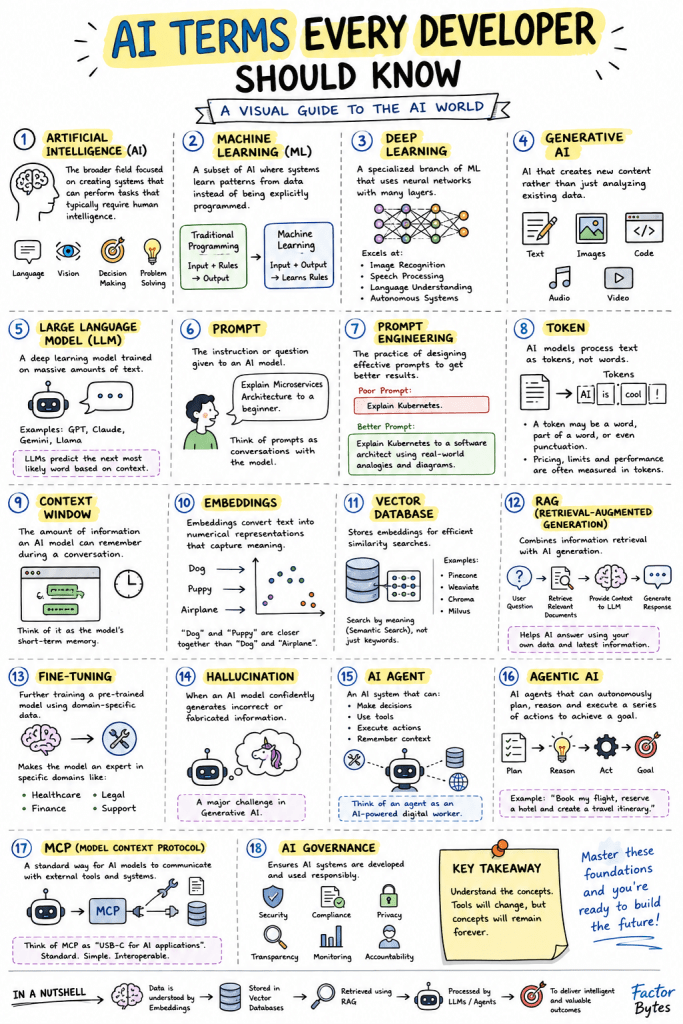
Artificial Intelligence today is transforming how we build software, automate business processes, and interact with technology. As developers and architects, we constantly hear terms such as Machine Learning, Large Language Models (LLMs), Embeddings, RAG, and Agentic AI. While these terms are frequently mentioned in conferences, blogs, and technical discussions, many developers and new comers are still trying to understand what they actually mean.
I often compare the current AI revolution to the rise of cloud computing. A decade ago, developers had to learn concepts such as Containers, Kubernetes, Microservices, and Serverless Computing. Today, AI is creating a similar learning curve. Understanding the terminology is the first step toward understanding the technology itself. Let’s explore some of the most important AI terms every developer should know.
1. Artificial Intelligence (AI)
Artificial Intelligence is the broader field focused on creating systems capable of performing tasks that typically require human intelligence. These tasks may include understanding language, recognizing images, making decisions, generating content, and solving problems. Think of AI as the umbrella under which all other AI-related technologies exist. Whenever you hear terms such as Machine Learning, Deep Learning, or Generative AI, remember that they are all subsets of Artificial Intelligence.
2. Machine Learning (ML)
Machine Learning is a subset of Artificial Intelligence that enables systems to learn patterns from data rather than relying entirely on rules written by developers. In traditional programming, developers provide the rules and data to produce an outcome. In Machine Learning, the system learns those rules automatically by analyzing historical data. This approach powers many applications we use every day, including recommendation engines, fraud detection systems, and spam filters.
3. Deep Learning
Deep Learning is a specialized branch of Machine Learning that uses neural networks with multiple layers to process and learn from large volumes of data. It is the technology behind many modern AI breakthroughs, including image recognition, speech processing, autonomous systems, and language understanding. Most of the advanced AI systems we interact with today are powered by Deep Learning models.
4. Generative AI
Unlike traditional AI systems that primarily analyze information, Generative AI creates entirely new content. It can generate text, images, videos, audio, and software code based on the instructions provided by a user. Every time you use ChatGPT to draft an article, generate code, or summarize information, you are interacting with Generative AI. This capability has opened up new opportunities for automation, creativity, and innovation across industries.
5. Large Language Models (LLMs)
At the heart of modern Generative AI are Large Language Models or LLMs. These models are trained on enormous amounts of text collected from books, websites, articles, and other sources. Their primary objective is to predict the next most likely word based on the context provided. While the concept sounds simple, the scale of training enables LLMs to answer questions, write content, generate code, and engage in conversations that often feel remarkably human.
6. Prompt
A Prompt is simply the instruction, question, or context provided to an AI model. It acts as the starting point for every interaction with an LLM. The quality of the response often depends on the quality of the prompt. A vague prompt typically produces a generic answer, while a detailed and context-rich prompt usually results in a more accurate and useful response.
7. Prompt Engineering
As AI adoption has grown, a new discipline called Prompt Engineering has emerged. Prompt Engineering focuses on designing prompts that guide AI models toward better outcomes. By providing clear instructions, context, constraints, and examples, developers can significantly improve the quality of responses generated by AI systems. In many cases, a well-crafted prompt can be more effective than making changes to the underlying model itself.
8. Token
AI models do not process text exactly as humans do. Instead, they break information into smaller units called Tokens. A token may represent a complete word, part of a word, or even punctuation. Understanding tokens is important because model pricing, context limits, and performance are often measured based on token usage. When working with enterprise AI solutions, tokens become an important consideration for both cost and scalability.
9. Context Window
The Context Window represents the amount of information an AI model can consider at a given time. Think of it as the model’s short-term memory. A larger context window allows the model to remember more information from a conversation or document, enabling it to provide more coherent and context-aware responses. As models continue to evolve, larger context windows are becoming increasingly valuable for enterprise use cases.
10. Embeddings
One of the most fascinating concepts in modern AI is Embeddings. Embeddings convert text, images, or other forms of data into numerical representations that capture meaning and relationships. This allows AI systems to understand concepts based on similarity rather than exact keywords. For example, the words “dog” and “puppy” would be considered closely related because their embeddings are located near each other in a mathematical space.
11. Vector Database
Since embeddings are stored as mathematical vectors, they require specialized storage systems known as Vector Databases. Unlike traditional databases that search for exact matches, Vector Databases search based on meaning and similarity. This capability enables applications to perform semantic searches and retrieve information that is contextually relevant, even when exact keywords are not present.
12. Retrieval-Augmented Generation (RAG)
Retrieval-Augmented Generation, commonly known as RAG, has become one of the most important enterprise AI architectures today. Large Language Models may not have access to an organization’s latest or private information. RAG addresses this challenge by retrieving relevant documents from trusted knowledge sources and providing that information to the model before generating a response. This approach improves accuracy and enables organizations to build AI solutions that leverage their own knowledge repositories.
13. Fine-Tuning
Fine-Tuning involves further training a pre-trained AI model using domain-specific data. While a general-purpose model can answer a wide variety of questions, Fine-Tuning helps it become more specialized in areas such as healthcare, finance, legal services, or customer support. Organizations often use Fine-Tuning when they require highly tailored behavior for specific business scenarios.
14. Hallucination
Despite their impressive capabilities, AI models are not perfect. A Hallucination occurs when a model confidently generates information that is incorrect, misleading, or completely fabricated. This may include invented facts, references, statistics, or events. Understanding and mitigating hallucinations remains one of the biggest challenges in building reliable enterprise AI applications.
15. AI Agent
An AI Agent goes beyond simply answering questions. It can make decisions, use tools, execute actions, and maintain context while working toward a specific objective. Think of an AI Agent as a digital worker capable of performing tasks on behalf of a user rather than merely participating in a conversation.
16. Agentic AI
Agentic AI represents the next evolution of intelligent systems. In an Agentic AI architecture, agents can plan, reason, make decisions, and execute multiple actions autonomously to achieve a goal. Rather than waiting for step-by-step instructions, these systems can determine the actions required to complete a task and coordinate their execution.
17. Model Context Protocol (MCP)
One of the emerging standards in the AI ecosystem is the Model Context Protocol (MCP). MCP provides a standardized way for AI models to communicate with external tools, applications, and data sources. Many experts describe MCP as the “USB-C for AI” because it simplifies integrations and enables interoperability across different systems and platforms.
18. AI Governance
As organizations scale their AI adoption, the importance of AI Governance continues to grow. AI Governance focuses on ensuring that AI systems are secure, ethical, transparent, compliant, and accountable. It provides the policies, frameworks, and controls required to balance innovation with responsibility. In many enterprises, governance is quickly becoming as important as the AI solutions themselves.
The AI landscape is evolving at an incredible pace, and new terms continue to emerge almost every month. However, understanding the foundational concepts provides a strong base for anyone looking to build modern AI-powered applications. If you understand concepts such as LLMs, Prompts, Embeddings, Vector Databases, RAG, AI Agents, MCP, and AI Governance, you are already well on your way to navigating the world of AI with confidence.
Technology trends will continue to evolve, but concepts endure. Invest time in understanding the concepts, and the tools will become much easier to learn.


Leave a comment